Super resolution cell layering to produce tubular tissue
QUOTE No: TEC1104445
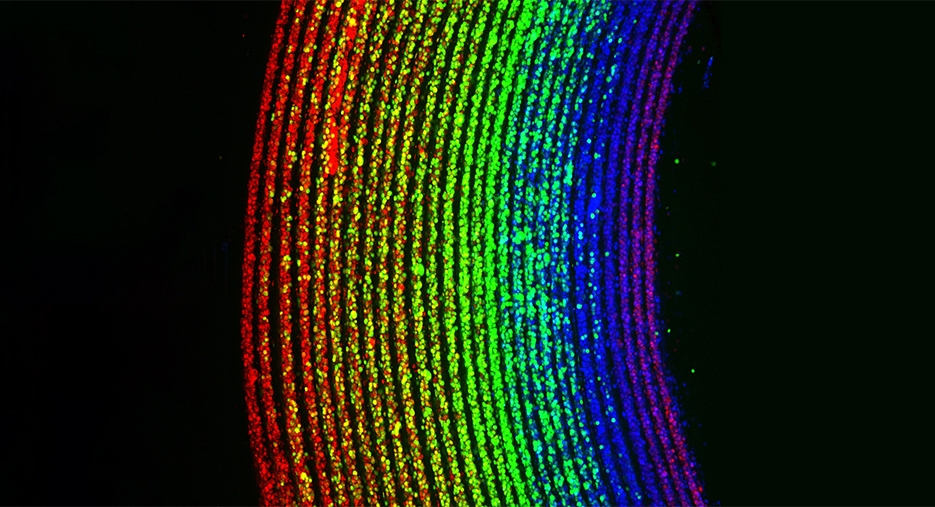
RIFLE single cell layers
At a glance
The technique, known as RIFLE – rotational internal flow layer engineering – enables the construction of separate layers down to one cell thick. RIFLE technology can be used to create human-layered tubular tissue for use in the development of new medicines and investigation of disease mechanisms, ultimately reducing the need to use animals in experiments.
Application
- The device can be used to generate tubular tissue using human cells and bioink.
Development Status
- The RIFLE development process is complete. A licensee will need to optimise the technique for the generation of their specific tissue of interest.
IP Status
- Priority patent filed 27th October 2022
- PCT application filed 25th October 2023
Commercial Offering
- Licensing or collaborative research
Opportunity
RIFLE is a low-cost and fast bio-fabrication method, which can work to a very small scale and provides a high-resolution alternative to 3D printing and other bio-fabrication methods. The technique is used to generate layered tissue from human cells and proteins. Theoretically, the RIFLE technique is compatible with all cells and proteins to generate bespoke tissues for your research.
Technology
The technique involves injecting a small volume of liquid-containing cells into a tube rotating at high speed – up to 9000rpm. The speed of the rotation causes the cells to distribute evenly across the internal surface of the tube, with higher speeds resulting in thinner layers. When this process is repeated, it builds up cell layers to create a tubular structure made of different, distinct layers, with a high density of cells. To date a number of cells and bioinks have been used to form tissue using the RIFLE technique, including ureteric cells, vascular cells and collagen.
Benefits
- Low-cost, fast method to create layered biological tissue.
- Ability to deposit human cells/ bioink to create desired structures to mimic human tissue.
- Reduces the need for animals in drug discovery/ disease mechanism research.
- Automated injection system to reduce human error when layering tissue.
Publications
Holland, I., Shu, W., & Davies, J. A. (2023). Stratified tissue biofabrication by rotational internal flow layer engineering. Biofabrication, 15(4), 045003. https://doi.org/10.1088/1758-5090/ace2ed
Interested in learning more?
Speak to our expert

Philippe Potey
Technology Transfer Executive
Philippe Potey bio
Philippe Potey
Technology Transfer Executive